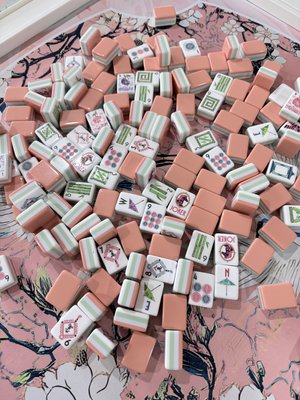
Jokers: Powerful, Flexible—and Often Misunderstood
Mahjong Insights – Issue No. 011
By Robin Gallop
Founder & Instructor, Mahjong Awaits™
Few tiles create as much excitement in American Mahjong as the Joker.
Draw one and your possibilities suddenly seem to expand.
Lose one and it can feel as though your entire hand has become more difficult.
Jokers are powerful.
But they're also frequently misunderstood.
Knowing what a Joker can—and cannot—do is an important part of learning American Mahjong.
What Does a Joker Do?
A Joker can substitute for another tile in certain groups.
That flexibility can help complete a pung, kong, quint, or sextet when you don't have every natural tile you need.
But a Joker is not simply a substitute for anything on the card.
There are rules governing where it can be used.
And those rules matter.
Jokers Cannot Be Used in Singles or Pairs
This is one of the most important Joker rules to remember:
A Joker cannot be used for a single tile or a pair.
If the hand requires a pair of 5 Craks, you need two actual 5 Craks.
A Joker cannot stand in for one of them.
The same applies to a single tile.
This means that when you're evaluating a hand, the singles and pairs often deserve special attention.
A rack full of Jokers won't help you complete a difficult pair.
Jokers Belong in Sets of Three or More
Jokers may be used in groups of three or more identical tiles.
That means they can help with:
Pungs
Kongs
Quints
Sextets
This is one reason Jokers can create so much flexibility in a developing hand.
But flexibility isn't the same as certainty.
You still need to build a legal hand that matches the card exactly.
Don't Build Your Entire Plan Around a Joker
A Joker can rescue a difficult set.
It can make a hand much more achievable.
But one Joker should not convince you that a weak hand is suddenly strong.
Look at the whole rack.
How many natural tiles do you already have?
What pairs do you need?
Are the remaining tiles realistic?
Are your needed tiles still available?
A Joker is helpful—but it doesn't replace good decision-making.
A Joker Can Be Exchanged
One of the most enjoyable parts of Joker strategy is the exchange.
If another player has an exposed set containing a Joker and you hold the natural tile that Joker represents, you may be able to exchange your natural tile for that Joker.
You place the natural tile into the exposed set and take the Joker into your own rack.
This can be a wonderful way to strengthen your hand.
It also means you should continue watching exposed sets throughout the game.
That Joker sitting across the table may eventually become yours.
You can also exchange as many Jokers as you have natural tiles for in one turn. However, don’t lay it down on the mat during an exchange or it could be called dead.
Protect Your Jokers
Because Jokers are valuable, newer players sometimes feel pressure to decide immediately how to use them.
You don't have to.
A Joker sitting on your rack gives you options.
As your hand develops, you may discover that it is more valuable in a completely different set than the one you first imagined.
Let the hand develop before committing whenever possible.
Jokers Can Reveal Information
An exposed Joker can also tell the other players something about your hand.
If you expose a kong with two natural tiles and two Jokers, everyone now knows exactly what those Jokers represent within that exposure.
They also know something about the structure of your hand.
That doesn't mean exposures are bad.
It simply means every exposure gives the table information.
As your experience grows, Joker management becomes part of both offensive and defensive strategy.
More Jokers Doesn't Always Mean a Better Hand
Imagine two possible hands.
One requires several natural pairs and singles.
The other requires large sets that can use Jokers.
If your rack contains multiple Jokers, the second structure may deserve more attention.
But you still need to consider everything else in your rack.
Jokers are one clue.
They are not the entire answer.
This is another reason we begin by reading the rack as a whole rather than choosing a hand based on one exciting tile.
The Joker Is a Tool
The best way to think about a Joker is as a tool.
A very useful tool.
But even the best tool only helps when it's used in the right place.
Understand where Jokers are legal.
Watch opportunities for exchanges.
Don't waste them.
Don't overvalue them.
And don't let them distract you from what the rest of your rack is telling you.
A Joker may give you flexibility.
But your decisions still build the hand.
Read the Rack. Let the Tiles Guide You.
And keep learning—
One Tile at a Time.
Mahjong Awaits™
Building Mahjong Communities One Tile at a Time.