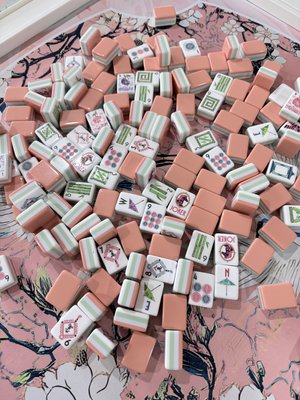
Reading the Table: What the Discards Are Telling You
Mahjong Insights – Issue No. 010
When you first learn American Mahjong, most of your attention is on your own rack.
What do I have?
What hand am I playing?
What should I discard?
That is exactly where a beginner should start.
But as you become more comfortable with the game, something begins to change.
You start looking beyond your own tiles.
You begin noticing what is happening on the table.
And suddenly, the discard pile becomes more than a collection of unwanted tiles.
It becomes information.
Every Discard Tells You Something
Once a tile is discarded, everyone at the table knows it is no longer hidden in someone's rack.
That matters.
Suppose your hand requires a particular 7 Bam and you already see three 7 Bams in the discard pile.
There may still be one available—but your chances of receiving it have become much smaller.
That doesn't necessarily mean you must immediately abandon your hand.
It does mean you should pay attention.
Mahjong is constantly giving you new information.
The players who learn to notice it have more information available when making their next decision.
Start by Watching Your Own Needed Tiles
You don't have to analyze everything on the table at once.
Begin simply.
Identify the tiles that are important to the hand you're building.
Then notice when those tiles appear in the discard pile.
If one goes out, make a mental note.
If another goes out, pay closer attention.
If several copies are gone, reevaluate how realistic your hand has become.
This is one of the easiest ways to begin reading the table without feeling overwhelmed.
Exposures Give You Even More Information
When another player calls a tile and makes an exposure, part of their hand is no longer a mystery.
You now know something about what they're building.
You may not know the exact hand yet, but an exposure can begin narrowing the possibilities.
What numbers are they showing?
What suit?
Are Flowers involved?
Dragons?
Winds?
Does the exposure fit only a few areas of the card?
You don't have to solve another player's hand immediately.
Just notice.
The more you play, the more naturally those clues will begin to connect.
Look for Patterns, Not Just Tiles
A single discard may not tell you very much.
A pattern of discards can tell you more.
If someone repeatedly discards one suit, perhaps that suit isn't important to their hand.
If certain Winds are disappearing quickly, a hand requiring those Winds may become harder to complete.
If a player exposes several sets that point strongly toward one section of the card, you may begin to recognize what they need.
Again, you don't have to know everything.
You are simply collecting information.
Your Own Discards Tell a Story Too
Remember that everyone else is watching the table as well.
The tiles you discard can give clues about your hand.
Your exposures certainly do.
That doesn't mean you should become afraid to discard.
It simply means American Mahjong is not played in isolation.
Four players are constantly revealing small pieces of information to one another throughout the game.
Part of strategy is learning to notice those pieces.
Know When the Information Matters
Early in the game, you may not have enough information to make strong conclusions.
Later in the game, the table becomes much more revealing.
More tiles have been discarded.
More exposures may be visible.
Fewer tiles remain in the wall.
At that point, knowing what is already gone can become very important.
A hand that looked wonderful ten turns ago may no longer be realistic.
Another hand may suddenly become stronger.
That's why we keep reevaluating.
Don't Let Table Reading Overwhelm You
Newer players sometimes hear experienced players discussing what everyone at the table might be playing and think:
"I will never be able to do that."
You don't need to do it all at once.
Start with one habit:
Watch for the tiles you need.
Then begin noticing exposures.
Later, start recognizing patterns.
Table awareness develops gradually—just like everything else in Mahjong.
The Game Is Giving You Clues
Your rack tells you part of the story.
The NMJL card gives you possible destinations.
The discard pile and the exposures around the table give you additional clues.
The more information you notice, the better equipped you are to decide whether to stay with your hand, pivot to another one, or begin playing more defensively.
Don't try to see everything.
Just begin looking beyond your own rack.
Because sometimes the tile that changes your decision isn't the one you draw.
It's the one someone else throws away.
Read the Rack. Read the Table. Let the Tiles Guide You.
And keep learning—
One Tile at a Time.
Mahjong Awaits™
Building Mahjong Communities One Tile at a Time.